1,000+ Romance Writing Prompts: How to Actually Use Them Without Getting Overwhelmed
Let's be honest about something.
You've probably bookmarked a writing prompt list before. Maybe you downloaded it, skimmed it, told yourself you'd come back to it, and then never opened it again. Not because you didn't need help, but because a list of five hundred prompts with no structure is just a different version of the blank page problem.
More options. Same paralysis.
That's the thing nobody talks about when it comes to writing prompts: the issue isn't having enough of them. It's knowing which one you actually need right now, for this scene, with this character, in this world.
The Spark was built to solve that specific problem. Here's how to use it without drowning in it.
Start With the Question, Not the Prompt
Before you open the pack, ask yourself one thing: what does this scene need to do?
Not what it needs to contain. Not what happens in it. What it needs to do: for the character, for the relationship, for the reader.
Is it supposed to build heat between two people who won't admit they're circling each other? Is it supposed to crack something open in a character who's been holding themselves together for three chapters? Is it supposed to land an emotional gut punch that the reader will feel twenty pages later?
That answer is your entry point. Everything else follows from it.
The Three-Axis System (and Why It Matters)
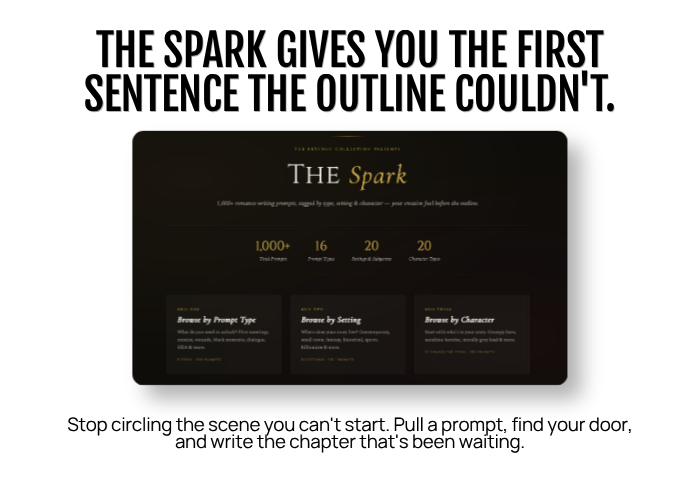
The Spark organizes over 1,000 prompts across three axes:
Prompt Type — what the scene needs to do. First meetings, tension igniters, wound backstory, black moments, dialogue sparks, slow burn stages, HEAs, sensory detail, and more. This is the functional axis. It tells you what job the prompt is designed for.
Setting — where your story lives. Small town, historical, fantasy and fae, sports romance, gothic estate, contemporary, medical, academia, diaspora, road trip, and more. This axis makes the prompt specific to your world rather than generic.
Character Type — who's in the room. Grumpy hero, ice queen heroine, morally grey hero, rivals and colleagues, wounded healer, golden retriever hero, reluctant hero, found family, and more. This axis builds the emotional logic into the prompt before you even start writing.
Every prompt card in The Spark shows all three tags. That means when you pull a prompt, you already know exactly what it's designed to do, where it lives, and who it was written for.
Three Ways to Browse (Pick One and Commit)
The homepage gives you three doors in. The key is to choose one and follow it through, don't try to use all three at once.
Browse by Prompt Type when you know what the scene needs to do but you're not sure how to start it. If you're writing a tension scene and you're staring at your characters in a room together with nothing happening, go to Tension Igniters. Pick the first prompt that makes you want to argue with it or push it further. That resistance is the scene.
Browse by Setting when the world is the thing you're trying to unlock. If your story lives in a small town and you need the town itself to feel like a character — the gossip network, the single coffee shop, the festival that puts everyone in the same place — start there. The setting prompts are calibrated for the specific rules and pressures of each world.
Browse by Character Type when the emotional logic of the scene is your problem. If you know you're writing a grumpy hero tension scene but every draft comes out flat, it's probably because the prompt you're working from isn't accounting for who he actually is. A grumpy hero in proximity is different from a golden retriever hero in proximity. The emotional mechanics are different. Start with the character.
How to Layer All Three Axes
Once you're comfortable with one axis, you can start combining them for the most targeted prompt possible.
Here's a real example: say you're writing a slow burn scene. Your setting is small town. Your hero is grumpy. You could:
Go to By Type → The Slow Burn Tracker and filter mentally for small town energy
Go to By Setting → Small Town and look for prompts tagged with slow burn or tension
Go to By Character → Grumpy Hero and find prompts in the acknowledgment or resistance stage
Any of those three paths gets you to a prompt that's calibrated for your exact scene. All three paths together give you a prompt that feels like it was written for your book.
What to Do With a Prompt Once You Have It
This is the part most prompt guides skip.
A writing prompt is a door, not a directive. You don't have to use it literally. You don't have to start with the exact scenario it describes. What you're looking for is the thing it unlocks — the image, the line of dialogue, the physical detail, the emotional beat that suddenly makes the scene make sense.
The best prompts are often the ones you immediately want to push back against. That's not quite right for my characters, but it is the beginning of a scene. Follow the but.
Some prompts will land immediately and you'll be writing in thirty seconds. Others will take you sideways into something you didn't know the scene needed. Both of those outcomes are the point.
A Few Practical Tips
Don't read the whole pack before you start using it. The Spark is a reference tool, not a book. You don't need to consume it linearly. Open it when you need it, pull one prompt, close it, and write.
The "Consider:" line is optional. Each prompt card has a follow-up nudge beneath the main prompt. Ignore it entirely if you're already moving. It's there for when you pull a prompt that's close but not quite landed yet, the consider line is a second door into the same scene.
Use the pack mid-draft, not just at the start. The Spark isn't only for the blank page before the outline. Some of the most useful prompts are the ones you pull when you're three chapters in and a scene isn't working. Wound backstory prompts are especially useful mid-draft when you realize you need to understand your character's damage more specifically before the next scene can land.
Bookmark your favorite pages. Once you find the sections that fit your subgenre and character types, pin them in your browser. The pack works offline, so you can have it open in one tab and your manuscript in another.
The Real Point
Writing prompts don't write your book for you. What they do — when they're specific enough and structured enough — is give you something to push against. They give the blank page a shape. They give the stuck scene a direction.
The Spark was built for the moment before the outline, the moment between chapters, and the moment in the middle of a draft when you've been staring at the same scene for three days and you need something — anything — to break the deadlock.
One prompt. One door. That's all it takes to start.
The Spark is available now as a digital download. 1,000+ romance writing prompts, tagged by type, setting, and character. Works offline in any browser. No account required.
The Betford Collection is a romance publishing services studio built around the Setting-as-Brand methodology. We build tools, resources, and publishing partnerships for romance authors who are serious about their craft and their brand.